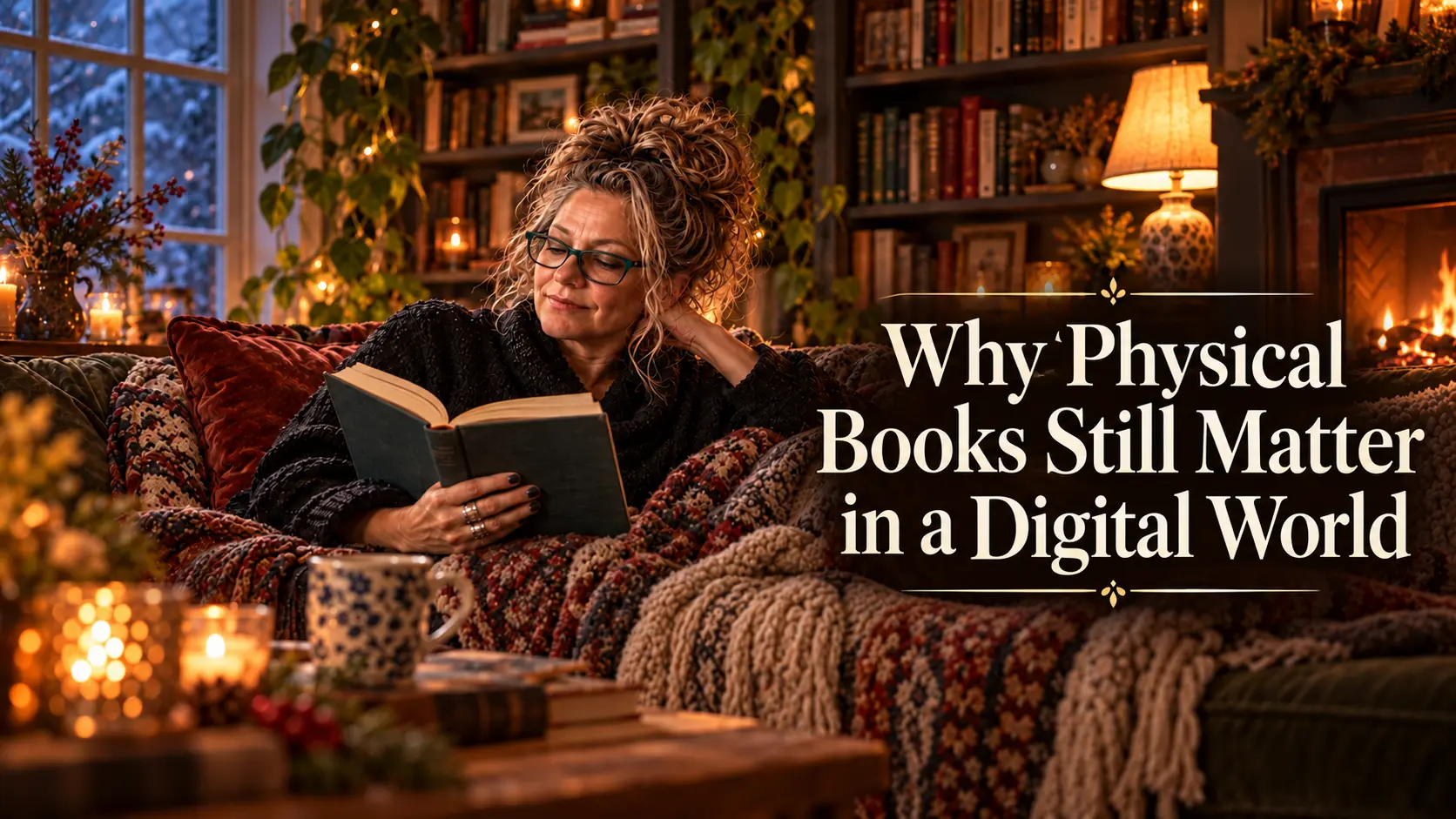
We can carry an entire library in our pocket. We can buy a novel at two in the morning, enlarge the text, search for a forgotten passage and take hundreds of books on holiday without adding a gram to the suitcase. Ebooks are useful, accessible and, for many readers, the easiest way to read.
So why do we still buy books we can hold?
The short answer: a physical book gives a story a place in our lives. Its pages, cover and marks can become part of the memories we make while reading it.
A Book Becomes Part of the Experience
The weight of a book changes as you move through it. The pages you have read gather under one hand while the unread pages grow thinner beneath the other. You can see your progress without a percentage in the corner of a screen, and when you finish, there is the quiet satisfaction of closing the cover.
Over time, a well-loved copy changes too. Its spine softens. A corner bends. Perhaps there is a tea stain on page 83 because you were so caught up in the story that you forgot where your mug was. None of this improves the words, but it makes that particular copy yours. The book starts to carry a record of being read.
The Copies We Keep Hold Memories
Most of us own at least one book that matters for reasons beyond its plot. It might be the paperback we took on holiday, the novel that helped us through a difficult year or a childhood favourite we cannot bring ourselves to give away. Pick it up again and you may remember the room where you read it, the weather outside and who you were at the time.
A second-hand book can carry someone else’s memories as well. There may be a name inside the cover, an inscription, a pressed flower or an old train ticket left between the pages. These small things were probably forgotten by the person who put them there. Years later, they can feel strangely precious. The book has a life before it reaches you, and sometimes you get a glimpse of it.
That is why replacing a battered favourite with a pristine new copy does not always feel right. The new one may be in better condition, but it has not been through anything with you.
Bookshelves Tell Our Stories Too
A bookshelf is rarely a tidy record of one consistent taste. It holds the books we loved as children, the subjects we became briefly obsessed with, recommendations from friends, gifts we would never have chosen for ourselves and perhaps one enormous book we remain absolutely determined to finish. One day.
Looking along a shelf can remind you of different versions of yourself. It can also bring a forgotten book back to your attention at just the right moment. A digital library may hold all the same titles, but the books on a shelf are part of your home. They wait in plain sight, quietly making the case for a reread.
Giving a Book Feels Personal
Sending someone an ebook is easy and often exactly what they need. Handing them a physical book has its own pleasure. You can choose a cover you think they will love, write a message inside and watch them open it. Years later, they might still have that very copy, with your handwriting on the first page.
The story belongs to the author, but the gift belongs to the two of you. Sometimes the inscription becomes as important as anything printed after it.
A Page Offers a Little Peace
So much of modern life arrives through a screen: work, messages, appointments, news and videos we did not mean to watch for forty minutes. A physical book offers a useful break from all of that. There is no notification tucked behind the next page and no sudden urge to check one small thing before returning to the chapter.
For some readers, that makes it easier to settle into a story. You open the book, and for a while, that is where you are. Even a few pages can feel like a proper pause.
Of course, plenty of people find the same escape in an ebook. Adjustable text and instant access can make reading possible or more comfortable. Many of us use both formats, choosing whatever suits the moment. The point is that convenience has not made the physical book lose its appeal.
More Than Something to Read
Physical books remain in our lives because they can become gifts, keepsakes and family possessions. They remind us what we loved, who gave us something and where we were when a story found us. A worn cover or folded page may look like damage to someone else; to us, it can be part of the reason we keep that copy.
We can store more words than ever before on a device small enough to fit in a pocket. That is wonderful. But sometimes we want the book on the shelf, the note inside the cover and the pages someone we love turned before us.
We do not only keep books for their stories. Sometimes we keep them for ours.
Think someone could use this?
If this made you think of someone, share it with them. Sometimes the right words find people at exactly the right time.
From our shelves
Find a book to hold on to
Discover stories from Mills & Burch Publishers, from children’s adventures to historical fiction and memoir.
Author and co-founder of Mills & Burch Publishers
Follow Mills & Burch Publishers on Facebook →