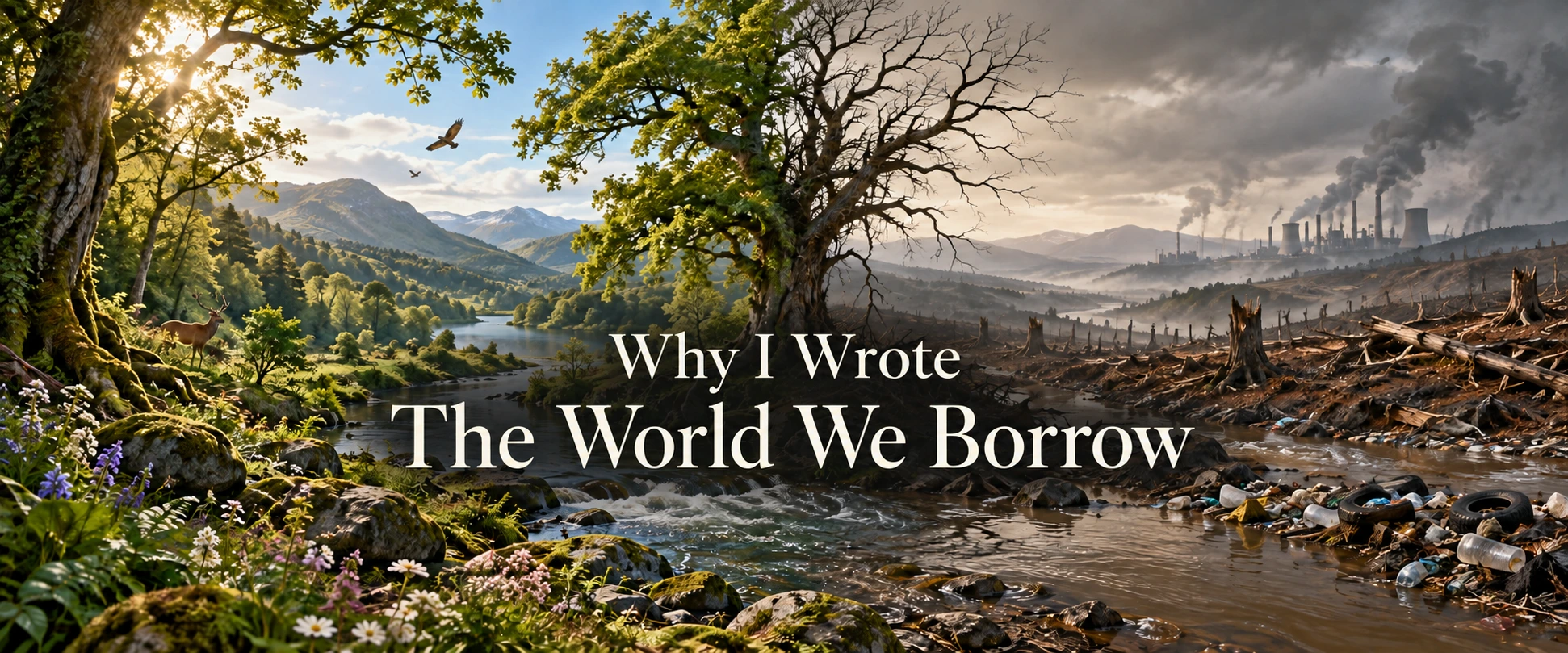
I wrote The World We Borrow because I kept coming back to one uncomfortable thought: we behave as though the Earth belongs to us, when we are only here for a little while.
Our land. Our oceans. Our forests. Our planet. We say it so confidently you would think somebody had checked the deeds.
Yet we arrive, spend a tiny patch of time here and eventually leave everything behind. The world carries on, becoming home to people we will never meet. They inherit what we leave, whether we have looked after it or made a spectacular mess.
That idea became the heart of my book. I wanted to explore our relationship with the world through a story—to give readers something to feel, imagine and carry with them after the last page.
The Wonder We Walk Past
One of the things that drew me to writing this story was how easily we overlook the extraordinary.
Forests grow from soil. Whales sing beneath the sea. Birds cross continents. A seed smaller than a fingernail can become a tree that outlives everyone who watched it being planted.
An entire living world is getting on with things around us, and familiarity has made us rather casual about it. We step over roots, swat at insects and complain about rain, forgetting how much our lives depend on the things we barely notice.
I wanted some of that wonder to sit beneath The World We Borrow. The feeling that this place is astonishing, even on an ordinary Tuesday when the washing needs doing.
Modern life makes it easy to lose that connection. Food comes from supermarkets, water from taps and electricity from sockets. We click a button and something arrives in a box, often inside another box, protected by enough packaging to survive an argument with a tank.
But everything came from somewhere. Materials were grown or extracted, energy was used and things were manufactured and transported. There is no magical cupboard behind civilisation producing endless supplies.
There is one planet, and an awful lot of us expecting it to keep providing.
What We Take—and What We Leave
I also wanted to explore the difference between how quickly we can destroy something and how slowly it may have grown.
A tree can spend a century becoming enormous and be felled in an afternoon. A place that has sheltered generations of wildlife can disappear before the creatures living there have anywhere else to go.
That troubles me. We can remove something without fully understanding what it supported, how long it took to develop or whether we can ever properly replace it.
Somewhere along the way, having enough stopped being enough. We are encouraged to want the next thing before we have properly used the last one. Perfectly serviceable possessions become disappointing because somebody has released a newer version in a slightly different colour.
I wanted my story to make room for the question underneath all that wanting: what are we willing to lose for the things we think we need?
The Lives Outside Our Own
The other creatures sharing Earth with us never agreed to this arrangement. Nobody consulted the hedgehogs before humans appointed themselves managers. There was no meeting, no vote and certainly no opportunity for an owl to object.
They simply experience the consequences. A hedge disappears. Water becomes polluted. A familiar route is blocked. Their world changes around them, and they must somehow manage.
When I was thinking about The World We Borrow, I kept returning to that responsibility. We can understand that a forest means more than timber and that a patch of land may already be somebody else’s home, even if its inhabitants don’t have a postcode.
That responsibility reaches forward, too. Future generations will live with decisions they had no chance to influence. They cannot ask us to leave them cleaner water, thriving woodland or places where wildlife still belongs.
We have to remember them without being reminded.
Why There Is Hope in the Idea
For all the sadness in those thoughts, I didn’t want the feeling behind this book to be only despair.
There is still so much worth caring about. Birds conduct unnecessarily loud business in the hedges. Bees disappear enthusiastically into flowers. Trees turn gold each autumn without demanding a premium subscription. The sea can still make a busy person stop talking and simply look.
People care, too. They restore habitats, protect wildlife, repair things and find better ways of living. Those efforts matter, even when they happen quietly and nobody is filming them.
Writing this story was my way of spending time with those questions: what we value, what we overlook and what might change if we paid more attention.
What I Hope Readers Take Away
I hope The World We Borrow leaves readers thinking about their place in the world—and perhaps looking a little more closely at the life around them.
The old tree they pass every day. The birds in the hedge. The small patch of flowers growing where somebody stopped mowing. Things that can seem like background until we imagine them gone.
Our time here is brief, but it gives us the chance to care for something that will outlast us. We can enjoy the world and help leave its beauty for somebody else.
That is why I wrote The World We Borrow. Because the world we leave becomes someone else’s beginning—and I think that is worth a story.
Think someone could use this?
If this made you think of someone, share it with them. Sometimes the right words find people at exactly the right time.
Read the book
The World We Borrow
A speculative novel by Emma Marnie. Jonathan wakes in a future Earth transformed by nature, where survivors live under the rules of the Balance.
Author of The World We Borrow and co-founder of Mills & Burch Publishers
Follow Mills & Burch Publishers on Facebook →