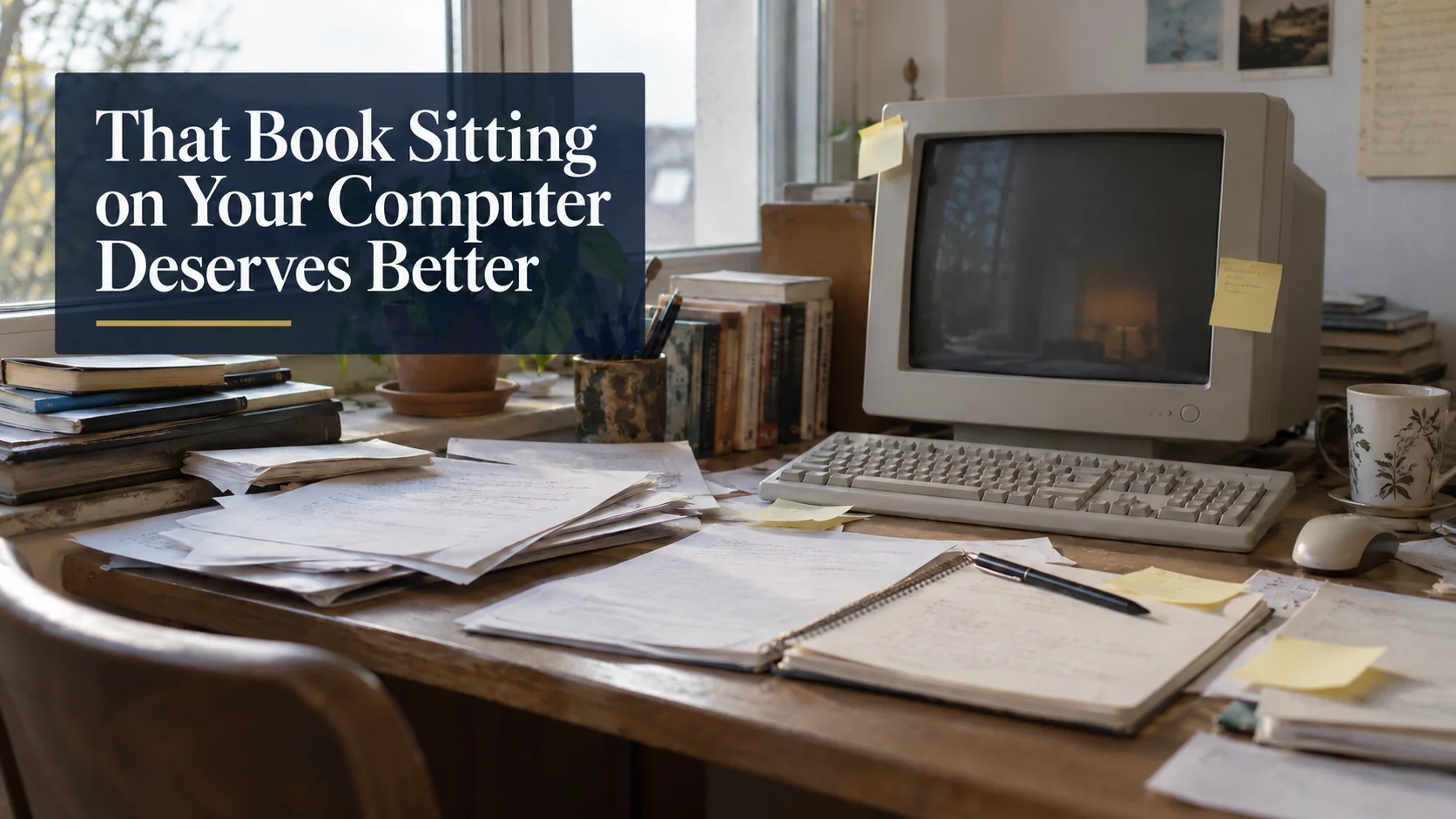
There are probably thousands of books sitting inside computers right now that nobody will ever read.
Finished manuscripts.
Half-finished manuscripts.
Children's stories written years ago.
Family histories somebody promised themselves they would publish one day.
Novels that have been rewritten so many times the author can practically recite the first chapter from memory.
And then there are the people who have actually finished their book, looked at the next stage and thought:
Now what?
Writing the Book Was Only the Beginning
Nobody really tells you how much other stuff comes after writing a book.
You start hearing about trim sizes, margins, bleed, ISBNs, cover dimensions, spines, keywords, categories, descriptions and something called KDP.
You upload something.
Amazon rejects it.
You change something.
Amazon rejects something else.
At some point you begin to wonder whether leaving the manuscript quietly sitting on your computer wasn't such a bad idea after all.
But it would be a shame.
Because you already did the hardest and most important part.
You had something worth putting into words.
And actually, those words don't even have to be neatly arranged yet.
It Doesn't Even Have to Be a Finished Manuscript
This is something we really want people to understand about Mills & Burch.
You don't necessarily need to arrive with 70,000 beautifully formatted words and a finished cover tucked under your arm.
We can start with scraps of paper.
Handwritten notes.
Pages that are completely out of order.
Old stories you've been adding to for years.
Different Word documents scattered around your computer.
A collection of memories.
Chapter ideas that haven't become chapters yet.
Research you've gathered but don't know how to turn into a book.
Even a great big muddle that makes perfect sense inside your own head but absolutely no sense to anybody looking at your desk.
Bring us the muddle.
We can help work out what belongs where, what you've actually got, what's missing and whether there's a book hiding inside it.
Sometimes publishing isn't about taking a finished manuscript and pressing a button.
Sometimes it's about helping somebody find the book they've already started writing without realising it.
Some Stories Are Hard to Go Back To
Not every manuscript is comfortable to write.
Some books deal with extremely difficult experiences, and sometimes simply getting those experiences onto the page has already asked an enormous amount of the author.
We understand that.
We have worked with material where repeatedly asking the author to go back through what they have written would be unnecessarily difficult for them.
In circumstances like these, we can take a particularly careful approach to the pre-publication process.
We can work through the manuscript, organise and prepare the material, carry out our pre-publication checks and deal with as much of the publishing process as reasonably possible without continually asking the author to revisit painful parts of their past.
There will always be occasions when we genuinely need an author's decision or approval. We won't make important personal decisions about somebody's story for them.
But we can make sure they aren't being asked to relive difficult experiences simply because there's another technical stage of publishing to complete.
Sometimes an author needs somebody to say:
You've told us your story. We'll handle it carefully from here.
That matters to us.
That's Where Mills & Burch Comes In
At Mills & Burch Publishers, we work with authors to take whatever stage their project has reached and help turn it into something that can actually sit on a bookshelf.
And we've learned something along the way:
Books don't arrive in perfect little packages.
Sometimes we receive a manuscript that's almost ready to publish.
Sometimes the story is finished but the formatting isn't.
Sometimes there's a cover but it won't fit Amazon's requirements.
Sometimes there are fifty pages, six notebooks, three versions of Chapter Four and absolutely no idea which one is supposed to come first.
That's okay.
We look at what you've got and work from there.
We've worked across fiction, children's books, personal stories, local history and books dealing with subjects that aren't always easy to write about.
No two projects are quite the same.
Which, frankly, is probably why we still enjoy doing it.
We Don't Believe Publishing Should Begin With a Huge Bill
One of the biggest things stopping people from publishing is money.
Traditional publishing can be extremely difficult to enter, while some publishing services ask authors for substantial sums before their book has sold a single copy.
Mills & Burch works differently.
For accepted manuscripts, we charge a one-off £100 commitment fee—not an expensive publishing package.
The fee is a small contribution towards the real time, preparation and practical costs involved in developing and publishing a book. We still invest substantial work and expertise in every project and agree a share of the royalties from future sales.
We explain the fee, royalty arrangement and responsibilities clearly before any work begins. Acceptance remains selective, and the fee is only requested after a manuscript is accepted.
That means our interests are rather nicely aligned.
We want your book to succeed too.
If the book achieves recognised and verifiable bestseller status while published with Mills & Burch—such as an official Amazon bestseller ranking or badge—the £100 commitment fee is refunded. Bestseller status is never guaranteed, but success deserves to be celebrated properly.
You Don't Have to Know How Publishing Works
This might be the most important bit.
You don't need to understand Amazon KDP before contacting us.
You don't need to know how wide your spine should be.
You don't need to understand bleed.
You don't need to have chosen seven perfect keywords.
And you certainly don't need to apologise because your writing isn't organised.
That's what we're here to help with.
What we need from you is the thing that can't be manufactured by a publishing company:
Your story.
Your knowledge.
Your imagination.
Your experience.
Your idea.
The rest can be worked on.
Don't Leave It Sitting There
If you've written something and it's been sitting on your computer, in a drawer, in a notebook or in a pile of papers because you don't know what to do next, dig it out.
Have another look.
It doesn't matter whether you started it last Tuesday or ten years ago.
Maybe it needs work.
Maybe it needs organising.
Maybe half of it is written on the backs of envelopes.
Maybe it's much closer to becoming a real book than you realise.
And perhaps the question isn't:
“Is this good enough to publish?”
Perhaps the better question is:
“Could this become a book?”
Bring us what you've got.
Let's find out.
Think someone could use this?
If this made you think of someone, share it with them. Sometimes the right words find people at exactly the right time.
You bring the story. We'll help you build the book.
Tell us what you have →